Dental Implants in Turkey
A guide to understanding dental implant packages in Turkey, helping you compare offers, understand what's included, and make informed decisions about your treatment.
You get a dental implant package from a clinic in Turkey.
It looks straightforward at first.
A few implants. A hotel. Transfers. One total price.
Then the real questions appear. What implant brand is this. Are abutments included. Are temporary teeth included. Is bone grafting extra. Is this one visit or two. What happens if the plan changes after the scan. Who helps if something feels wrong after you go home.
That moment matters.
This guide is for that moment.
It is not here to talk you into treatment. It is here to help you slow down, understand the decision, and compare offers with a clear head.
A dental implant offer can look simple until you ask what it includes
Implant offers are hard to compare because the total price rarely tells the whole story. Two offers can look similar and still differ in the implant system, the number of implants, the type of abutments and crowns, whether scans are included, whether temporary teeth are included, and what happens if the in-person examination changes the plan. Turkey’s current international health tourism rules require authorized providers to issue invoices and, when patients ask, to provide a detailed breakdown of services and copies of tests and radiology they paid for. That helps. But you still need the quote to spell out what is included and what is not.
Many patients consider dental implants in Turkey because the first quote looks lower than the quote at home, because Turkey has an established international health tourism system, and because providers serving international patients often work in foreign languages and structured coordination pathways. None of that proves that any specific clinic is right for you. The real decision is still the provider, the treatment plan, the materials, the support, and the follow-up.
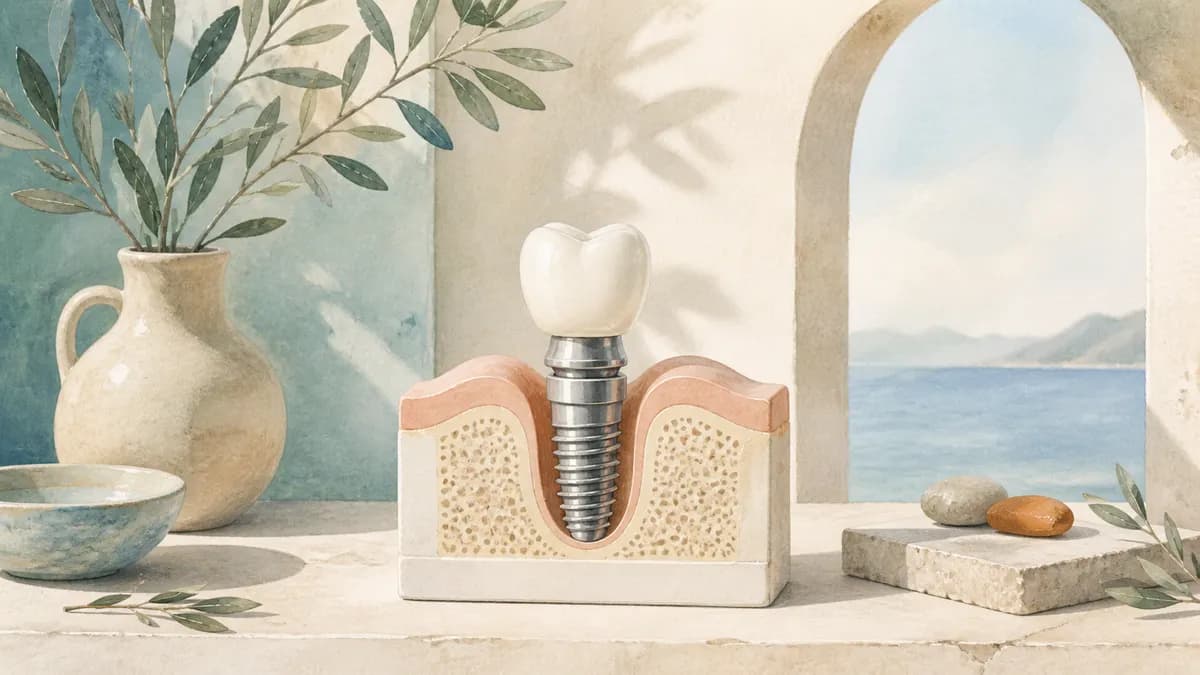
A dental implant itself is not the tooth you see. It is the fixture placed in the jawbone. On top of that sits an abutment, which is the connector. On top of the abutment sits the visible restoration, such as a crown, a bridge, or a denture. The bone then needs time to heal and fuse to the implant. That healing step is a big part of the timeline, and it is one reason implant quotes need more explanation than a simple package price.
A crown is different from an implant. A crown can cover a natural tooth. An implant replaces the missing root and then supports a crown, bridge, or denture. If you understand that difference, clinic quotes start to make more sense.
Single teeth, several teeth, and full-mouth treatment
One missing tooth is the simplest concept to understand. One implant may support one crown. Several missing teeth may be replaced with several implants and individual crowns, or with an implant-supported bridge. In some cases, a removable overdenture may attach to implants instead of resting loosely on the gums. In other cases, the prosthesis is fixed and can only be removed by the dentist for maintenance.
This is where many “full mouth dental implants Turkey” offers become confusing. “Full mouth” can mean one arch or both arches. It can mean a fixed full-arch bridge, a removable overdenture, or a hybrid design. It can also mean temporary teeth now and final teeth later. A label like “full mouth,” “full arch,” or “All-on-6” is not enough on its own. You need the exact number of implants being placed and the exact number and type of prosthetic teeth included.
“All-on-4” is one specific full-arch concept. It means a fixed denture for one arch supported by four implants. Some clinics also use terms like All-on-6 or All-on-X for other full-arch designs. The useful question is not which label sounds better. The useful question is what is actually planned for your mouth, your bone, and your bite.
If an offer is vague, ask whether it covers one jaw or both, how many implants are planned for each jaw, whether the teeth are fixed or removable, and whether the teeth shown in the package are temporary or final. That single step will make it much easier to compare two offers fairly.
Can dental implants be done in one trip
Sometimes, yes.
But “yes” can mean very different things.
A single implant can sometimes be placed immediately after extraction if the conditions are suitable. A temporary tooth may also be used in some cases, especially at the front of the mouth. For immediate-load treatment, the temporary restoration can be placed the same day, but the final custom crown is often placed months later after healing.
The same idea applies to many “teeth in one day” or “All-on-4 Turkey” offers. Same-day treatment often means implants plus a temporary full-arch prosthesis. The final teeth are commonly delivered after a healing period and further appointments. In other words, “same day” does not automatically mean “final.”
Some patients genuinely can complete the key surgical step in one trip. Others cannot. If extractions are needed first, if bone grafting is needed, if a sinus lift is needed, or if the case is more complex, the timeline can stretch by months. Bone grafting can be done at the same time in smaller defects, but larger grafting often happens months before implant placement. Sinus grafting also adds complexity and time.
Implants may also be done as one-stage or two-stage surgery. In one-stage cases, the healing cap may be visible right away. In two-stage cases, the implant is covered during healing and uncovered later in a second minor procedure. That is another reason two quotes with the same headline may hide different timelines and different numbers of visits.
If a clinic says you can do everything in one trip, ask one calm follow-up question: are those the final teeth, or temporary teeth while the implants heal. That question alone will clear up a lot.
What affects cost and what should be in the quote
The price matters.
But the structure of the price matters more.
The biggest cost drivers are usually the number of implants, the implant brand, the type of restoration, the crown or bridge material, whether teeth need to be removed first, whether bone grafting or a sinus lift is needed, whether temporary teeth are included, whether sedation is planned, and whether scans, hotel, transfers, and follow-up are bundled into the offer. Material choices also matter because different indirect restorative materials have different properties, indications, durability, appearance, and cost.
If you are searching for “dental implants Turkey cost” or “dental implants Turkey price,” the honest answer is that there is no single useful number. A quote can change after the clinic examines you, checks the scan, and sees the real condition of your bone, gums, bite, and any teeth that may need removal first. That is why a fixed headline price can mislead if the underlying plan is still unclear.
A useful quote should tell you all of the following.
- What diagnosis the clinic is working from, and what scans or imaging are included
- How many implants are included
- The implant brand and, ideally, the model
- How many crowns, bridge units, or prosthetic teeth are included
- Whether abutments are included
- Whether temporary teeth or a temporary prosthesis are included
- Whether extractions are included
- Whether bone grafting or sinus lift is included, excluded, or only “if needed”
- Which medicines are included
- Whether hotel, transfers, interpretation, or coordination are included
- How many follow-up appointments are included in Turkey
- What documents you will receive before you leave
- What warranty is offered, in writing
- What is explicitly excluded
- What happens to the price if the treatment plan changes after the in-person examination
If the quote does not clearly show exclusions, ask for them in writing. “Not included” is just as important as “included.” Turkey’s official health tourism rules specifically require detailed billing and a breakdown of intermediary services such as accommodation, transport, transfer, interpretation, and consultancy when requested. That makes detailed written quotes a reasonable thing to ask for, not a difficult thing to ask for.
Implant brands, crown materials, and warranty
The brand matters because implant treatment is a system, not just a screw.
Common systems you may see in dental implant brands Turkey quotes include Straumann, Nobel Biocare, Dentsply Sirona, and ZimVie. The point is not to chase one famous name. The point is to know exactly what system and components your clinic plans to use, because parts, compatibility, documentation, future servicing, and maintenance can all depend on that choice. Manufacturers themselves emphasize original components, system matching, and long-term parts availability.
Ask for the implant brand and model in writing. Ask for an implant passport or implant card before you go home. Major manufacturers provide patient documentation for this purpose, and those records help if another dentist needs to understand what was placed years later.
Warranty is the next place where patients get confused. A manufacturer warranty is not the same thing as a clinic warranty, and neither is the same thing as a guarantee of outcome. Manufacturer programs may replace certain failed components, but they can exclude treatment costs, travel costs, hotel costs, and other practical expenses. Some manufacturer warranty programs are written mainly for treatment providers rather than directly for patients.
That is why “dental implant warranty Turkey” should mean a written document you can actually understand. Ask exactly what is covered, for how long, under what conditions, and who pays if remedial care requires extra visits, new lab work, or new travel. Ask whether the warranty covers the implant fixture, the abutment, the crown or bridge, or only the manufacturer’s replacement part. Ask what maintenance you must keep up to preserve it.
The visible tooth also matters. The implant fixture is hidden inside the bone. The visible part is the restoration. Crown material affects appearance, strength, wear, and cost. Broadly speaking, indirect restorative materials vary in composition, indications, mechanical properties, and aesthetics. Ceramic families such as zirconia are popular because they are tooth-colored, while metal-ceramic options such as porcelain-fused-to-metal combine a metal core with a porcelain exterior. No single material is best for every case. The right question is why that material is being recommended for your case.
Temporary teeth are not the same as final teeth. Temporary crowns are often made from resin or acrylic. They can look surprisingly good, but they are not the same thing as the final long-term restoration. If a clinic shows beautiful smile photos, ask whether the images show temporary or final teeth.
Be especially careful if an implant quote is mixed with a large cosmetic plan. Crowns cover the whole tooth. Veneers cover the front surface only, but they still usually require some enamel removal. If a plan includes crowns or veneers on natural teeth, understand exactly which teeth are being permanently altered and why. Do not accept a full cosmetic package unless you understand how much natural tooth or bone structure is involved.
Safety, clinic comparison, and red flags
When people ask, “is dental work in Turkey safe,” the most useful answer is not yes or no.
Turkey has an official international health tourism authorization system overseen by the Ministry of Health of Türkiye. Health facilities need an authorization certificate to operate in that framework, and the Ministry publishes lists of authorized hospitals, medical centers, private practices, and other providers through ministry channels and the official portal HealthTürkiye. Current rules also require foreign-language website access and publication of the relevant certificate on the provider’s website.
That official framework matters. But it does not make the decision for you. Safety still depends on the individual provider, the examination, the plan, the infection-control standards, the materials, the way risks are explained, and the quality of follow-up. UK public health guidance and patient guidance both stress that people traveling for treatment should verify qualifications independently, speak to the treating clinician, and understand aftercare before booking.
Dental implants are surgical treatment. A serious provider should ask about your medical history, medicines, allergies, smoking, diabetes, gum health, bone quantity, and any previous dental treatment. Proper planning is based on examination and imaging, often including 3D imaging when needed. Smoking, gum disease, poor bone conditions, and uncontrolled health issues can affect suitability and outcomes.
No provider can guarantee a result. That is not how surgery works. Good patient information from periodontal specialists makes the point clearly: no tooth replacement option can be assured to be permanent. A serious provider explains risks, limits, complication pathways, and long-term maintenance instead of promising a perfect result.
When you compare a dental clinic in Turkey, compare the treatment plan, diagnostics, who actually performs the surgery, the provider’s qualifications and experience with implant cases, the implant system, the restorative materials, the expected number of visits, the written inclusions and exclusions, the warranty terms, the quality of communication, and the aftercare process. A fast reply and a polished Instagram page are not enough.
Some red flags are simple.
- The implant brand is unclear
- There is no written treatment plan
- A “full mouth” offer is vague about arches, implants, and prosthetic teeth
- You are pushed to book quickly or pay a deposit before your questions are answered
- Nobody asks about your medical history, smoking, or medications
- There is no mention of scans, bone quality, or what happens if the plan changes after examination
- The warranty is vague or verbal only
- The clinic cannot explain who you contact after you return home
- The price changes without a clear clinical reason
- You are promised guaranteed or perfect results
A patient-friendly provider should be able to answer plain questions in plain language. If that does not happen before payment, do not expect it to improve after payment.
Before travel, while in Turkey, and after you return home
Before you travel, talk to your own dentist or doctor if you can. UK guidance specifically recommends discussing planned treatment abroad with your usual clinician before you commit. Bring recent dental records if you have them. Bring your medical history, medication list, allergy list, smoking status, and a short summary of major past dental work. Keep copies of every written offer and every message that explains the plan.
Give yourself recovery time, not just treatment time. Build in days for unexpected changes. Think about whether you want a companion, especially for longer surgery, sedation, or a complex full-arch case. Check your insurance carefully. Standard travel cover usually focuses on emergencies, while planned or non-urgent treatment is often excluded. Declare pre-existing conditions to your insurer, because non-disclosure can invalidate claims.
While you are in Turkey, the key moment is often the first in-person examination. If the clinic changes the plan after scanning or examining you, ask for the revised plan and revised price in writing before you sign or pay. Ask who is performing each stage. Ask for your documents, scans, and invoices. If hygiene, safety, or communication feels wrong after arrival, you do not have to proceed.
Before you leave Turkey, make sure you have the records you will need later. That means your scans or radiology, your invoice, your treatment summary, any medicine list or prescriptions, and your implant passport or implant card if implants were placed. Written documentation matters more after you get home than it does on the day you feel relieved to be finished.
After you return home, remember that healing questions are normal. Some early soreness, swelling, bruising, or minor bleeding can happen after implant surgery. But ongoing or worsening pain, severe swelling, uncontrolled bleeding, fever, a bad taste, or a loose restoration deserve prompt advice from the treating clinic and, when needed, a local dentist or urgent dental service.
Follow-up is where many dental tourism problems become real. UK travel health guidance warns that follow-up care may not be easily available and may not be covered, and that complications can appear weeks or months later. Hospital guidance also notes that your local dentist can look after implants, usually at your own cost. Keep your communication with the clinic in writing as much as possible. Keep every radiograph, invoice, and passport.
Questions to ask before you accept an offer
Use this list before you say yes to any implant package. It is one of the simplest ways to learn how to compare dental implant offers properly.
- How many implants are included
- Which implant brand and model will be used
- Are abutments included
- Which crowns, bridge units, or prosthetic teeth are included
- Are temporary teeth included
- Are extractions included
- Is bone grafting included if needed
- Is sinus lift included if needed
- Is the first examination and scan included
- What happens if the plan changes after the scan
- How many visits are needed
- How long should I stay in Turkey for each visit
- Who performs the surgery
- What documents will I receive before I leave
- What written warranty is provided
- What is not included
- Who do I contact after I return home
How Kopru helps
Kopru does not make the medical decision for you.
It helps you understand the decision you are making.
That can mean helping you read a quote more carefully, comparing what two offers actually include, spotting what is missing, preparing better questions before you travel, keeping communication clear while you are in Turkey, and staying organized when follow-up starts after you are back home.
That kind of support matters because patients often do not need more sales language.
They need clarity.
They need time.
They need someone to help them stay steady before, during, and after treatment.
FAQ
Are dental implants in Turkey safe?
They can be, but safety is not a country-wide yes or no. Turkey has an official authorization framework for international health tourism, but you still need to check the individual provider, the treatment plan, the records, the communication, and the follow-up process.
How much do dental implants cost in Turkey?
There is no single useful number. The final cost depends on the number of implants, the implant system, the restoration type, scans, extractions, grafting, temporary teeth, sedation, travel services, and what happens after the in-person examination.
Why are dental implants often cheaper in Turkey?
Many patients start looking at Turkey because the quote appears lower than the quote at home and because Turkey actively serves international patients. But a lower headline number does not tell you whether two offers include the same treatment, materials, or follow-up.
How many days do I need to stay in Turkey?
That depends on the procedure, whether extractions or grafting are needed, and whether you are receiving temporary or final teeth. Some surgical steps can happen in one trip, while final restorations may happen months later.
Can I get dental implants in one trip?
Sometimes. But in many cases, one trip means implant placement plus temporary teeth, not final teeth. Healing and final restoration often take additional time or a second visit.
What is All-on-4?
All-on-4 is a specific full-arch method that replaces one arch of teeth with a fixed denture supported by four implants. It is not the same as every “full mouth” or “full arch” offer, so ask exactly what your clinic means.
What implant brands should I ask about?
Ask for the exact brand and model the clinic plans to use and ask for that in writing. Common names in the market include Straumann, Nobel Biocare, Dentsply Sirona, and ZimVie, but the real issue is system identification, documentation, and future maintenance, not brand prestige alone.
What should a dental implant warranty include?
It should say what is covered, what is excluded, how long it lasts, what maintenance is required, and who pays for extra treatment, lab work, flights, or hotels if something fails. Manufacturer warranties often cover replacement parts only and may not cover the broader costs patients actually worry about.
What happens if I have a problem after returning home?
Keep all records and contact the treating clinic in writing. If you have worsening pain, swelling, bleeding, fever, or anything that feels loose, seek prompt dental advice locally as well. Follow-up problems after treatment abroad can be difficult and may not be covered as part of routine care at home.
How can I compare two dental implant offers?
Put the offers side by side and compare the treatment plan, number of implants, implant brand, type of prosthesis, temporary teeth, scans, grafting, exclusions, visit plan, provider qualifications, aftercare, and written warranty. If one quote is shorter, vaguer, or more rushed, that is important information too.
If an offer still feels unclear after you read it twice, that is usually a sign to pause, ask better questions, and keep every answer in writing.